Working hours: Monday-Saturday: 08:00-18:00, Sunday: closed
 +995 599 48 48 44
 info@medindex.ge
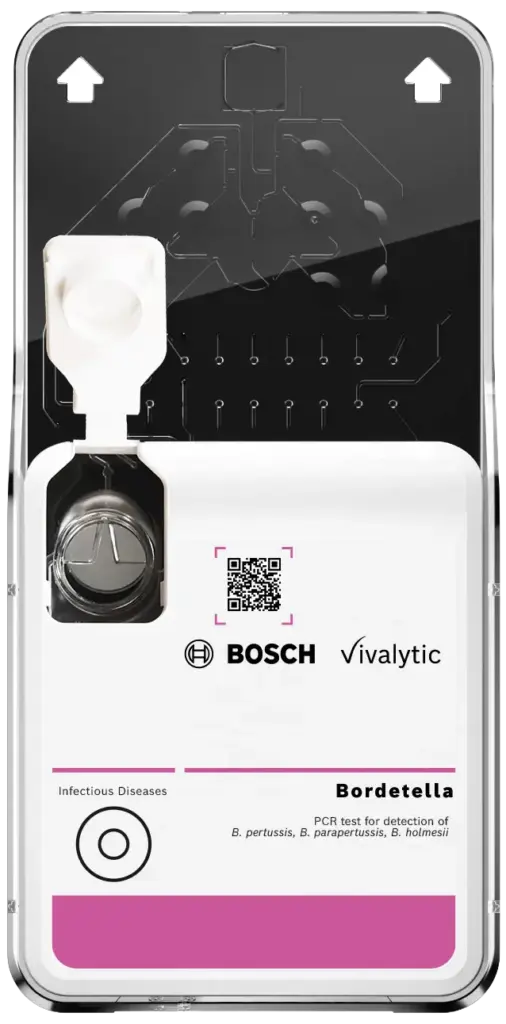
Vivalytic cartridge for detecting Bordetella pathogens.
We will be happy to give you a personal consultation and look forward to your request
A qualitative RT-PCR test detecting B. pertussis, B. parapertussis and B. holmesii from a nasopharyngeal swab with a 47-minute time to result, helping prompt treatment and reducing airborne transmission. Real-time PCR enables targeted detection up to four weeks after symptom onset and differentiates the human-pathogenic Bordetella species. Pertussis (whooping cough) is a droplet-transmitted respiratory infection caused by a gram-negative bacterium; faster identification supports timely therapy and lowers infection risk for the user. Works in laboratory and non-laboratory settings with a 4-step workflow. Workflow is four steps (enter sample data, scan cartridge, load sample, insert cartridge); the touchscreen shows countdown and results, and several units can connect wirelessly to a master Vivalytic.
| Sample type | Nasopharyngeal swab |
|---|---|
| Sample volume | 300 μl |
| Detection method | Real-Time PCR |
| Time to result | 47 min |
| Pathogens detected | B. pertussis, B. parapertussis, B. holmesii |
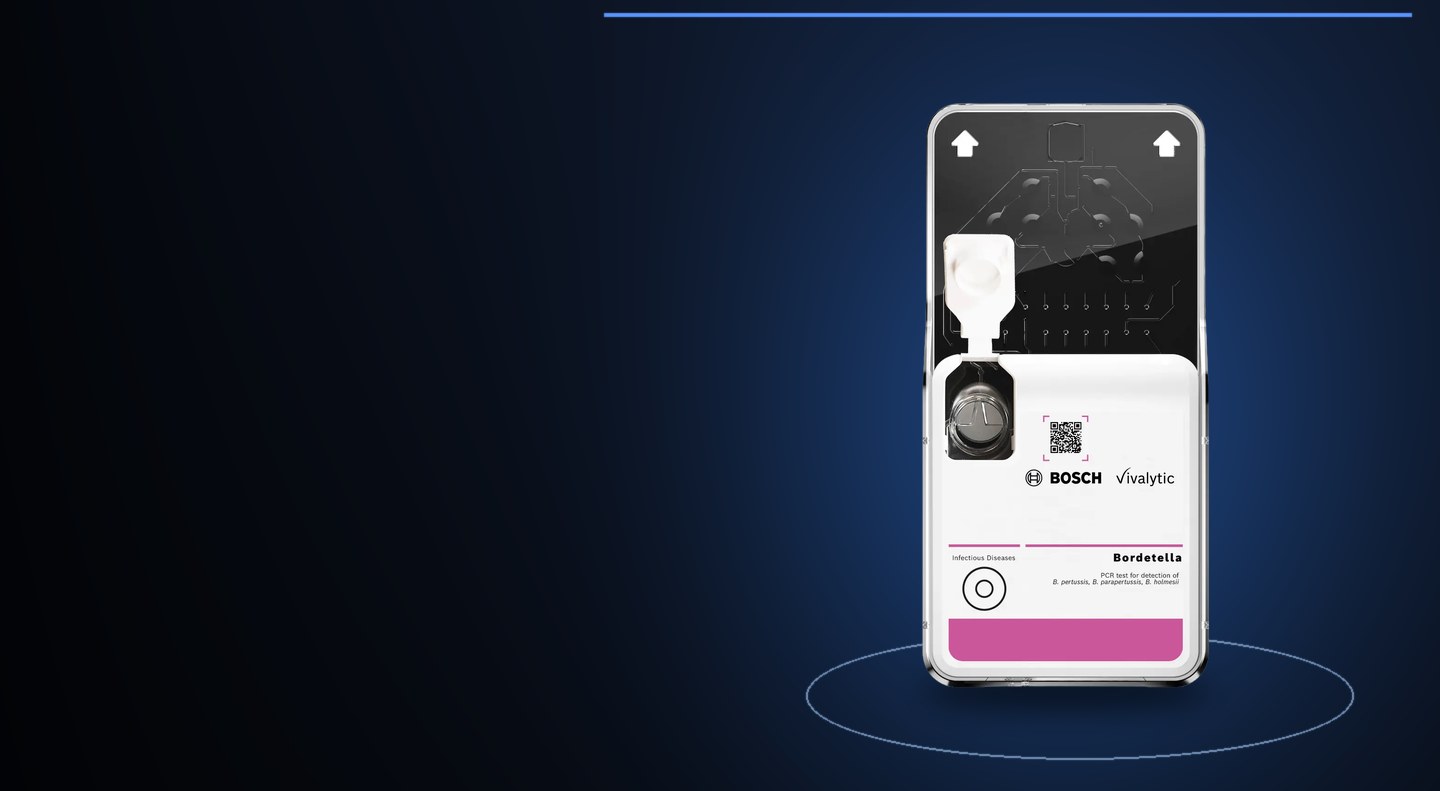
Qualitative RT-PCR detection of Bordetella species: B. pertussis, B. parapertussis and B. holmesii.
Result in 47 minutes, reducing airborne transmission.
Real-time PCR detects the bacteria up to 4 weeks after symptom onset.
From sample loading to result; suitable for laboratory and non-laboratory settings.
Nasopharyngeal swab, volume 300 μl.
B. pertussis, B. parapertussis and B. holmesii on a single panel.
Bordetella pertussis causes whooping cough and is transmitted by droplets. The Vivalytic Bordetella test detects the bacterial species and supports timely initiation of appropriate treatment.
The user scans or enters the sample information, then the cartridge code is scanned in the Vivalytic software.
Add the sample to the cartridge port, close the lid and insert the cartridge into the Vivalytic.
The touchscreen shows the time remaining until the test is complete, and the results then appear on screen.
Several Vivalytic units connect to each other wirelessly and send results to the main Vivalytic platform.